

mRNA incorporation of C(5)-halogenated pyrimidine ribonucleotides and induced high expression of corresponding protein for the development of mRNA vaccine
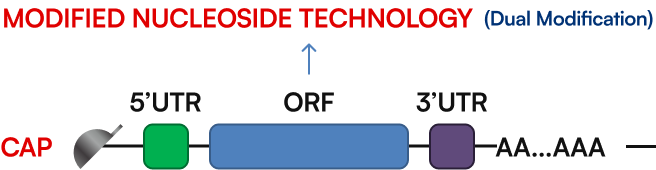
In this report, we present our studies on mRNA, which was modified by introducing various halogen substituents at the C(5) position of the pyrimidine base. Specifically, we synthesized C(5)-halogenated (F, Cl, Br, I) pyrimidine ribonucleoside triphosphates and incorporated them into mRNA during in-vitro transcription.
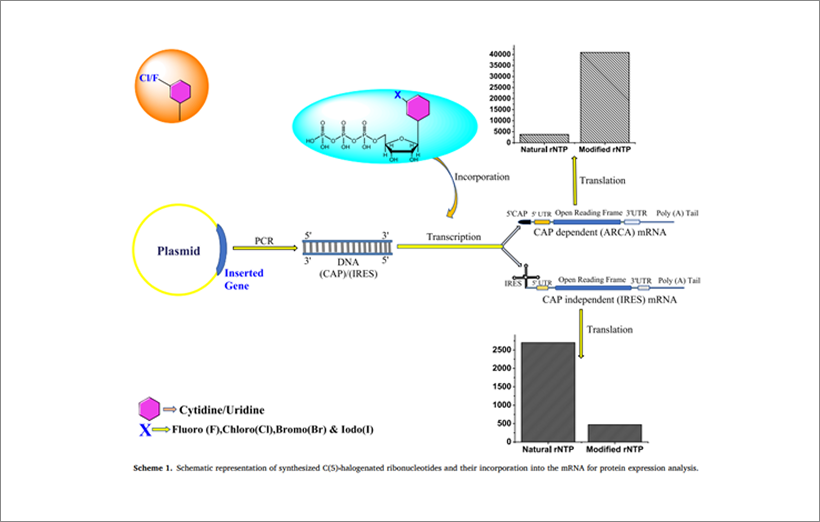
The efficiency of the in-vitro transcription reaction of halogenated pyrimidine was observed to decrease as the size of the halogen substituent increased and the electronegativity thereof decreased (F > Cl > Br) except for iodine.
Interestingly, we found that, among the C(5)-halogenated pyrimidine ribonucleotides, mRNA incorporating C(5)-halogenated cytidine (5-F rCTP and 5-Cl rCTP) exhibited more prominent protein expression than mRNA modified with C(5)- halogenated uridine and unmodified mRNA.
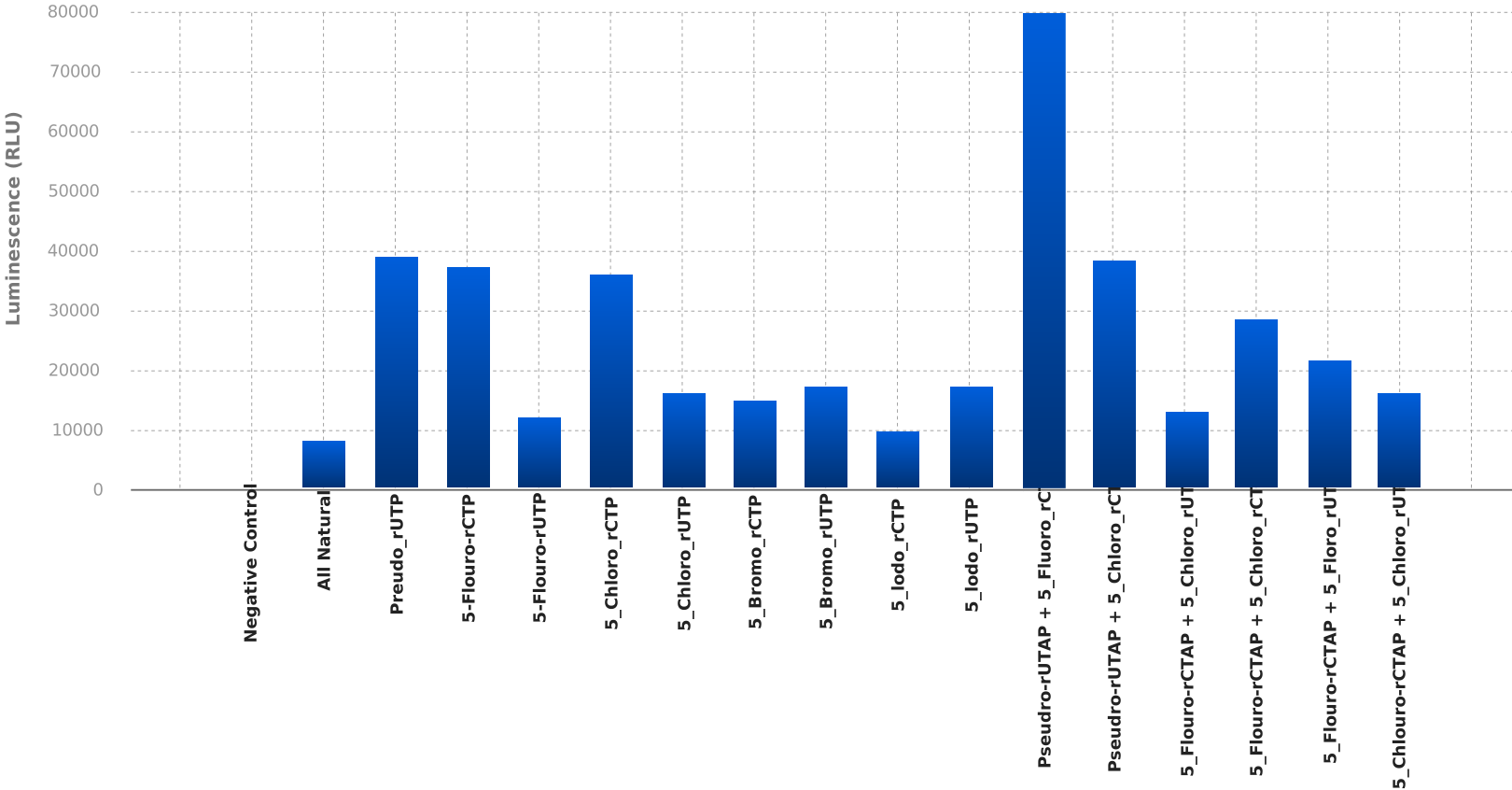
In particular, in the case of mRNA to which fluorine (5-F rCTP) and chlorine (5-Cl rCTP) were introduced, the protein was dramatically expressed about 4 to 5 times more efficiently than the unmodified mRNA, which was similar to pseudouridine (ψ).
More interestingly, when pseudouridine(ψ) and fluorocytidine nucleotides (5-F rCTP), were simultaneously introduced into mRNA for dual incorporation, the protein expression efficiency dramatically increased as much as tenfold.
The efficiency of cap-dependent protein expression is much higher than the IRES-dependent (internal ribosome entry site) expression with mRNA incorporating C(5)-halogenated pyrimidine ribonucleotide. We expect these results to contribute mean- ingfully to the development of therapeutics based on modified mRNA.